
Image by marymarkevich from Magnific.
Self-expression values prioritize subjective well-being, autonomy, and quality of life
Self-expression societies, according to Inglehart and Welzel, prioritize subjective well-being, individual autonomy, freedom, and quality of life over basic material needs. These societies emphasize environmental protection, tolerance toward outgroups (including foreigners, gays and lesbians), gender equality, and rising demands for participation in economic and political decision-making. They feature high interpersonal trust, political moderation, and a shift in child-rearing values from obedience and hard work toward imagination and tolerance. This reflects an emancipative, humanistic ethos that values human choice and self-realization, emerging strongly in post-industrial societies with high existential security. Such societies show high support for gender equality, environmental activism, and low support for authoritarian government, alongside greater acceptance of diversity and personal expression.
Survival societies, e.g. the African-Islamic cluster in the Inglehart–Welzel Cultural Map (2023), represent the opposite pole. They place primary emphasis on economic and physical security amid conditions of existential insecurity. These societies exhibit ethnocentric outlooks, low interpersonal trust, and intolerance toward outgroups, including resistance to cultural change, ethnic diversity, and non-traditional gender roles or sexual norms. They prioritize materialist values (e.g., maintaining order and fighting inflation), show lower subjective well-being and reported health, and favor authoritarian government for predictability. When survival feels threatened, people cling to familiar rules and view diversity as risky. This dimension also correlates with industrial-era constraints on autonomy and lower civic engagement.
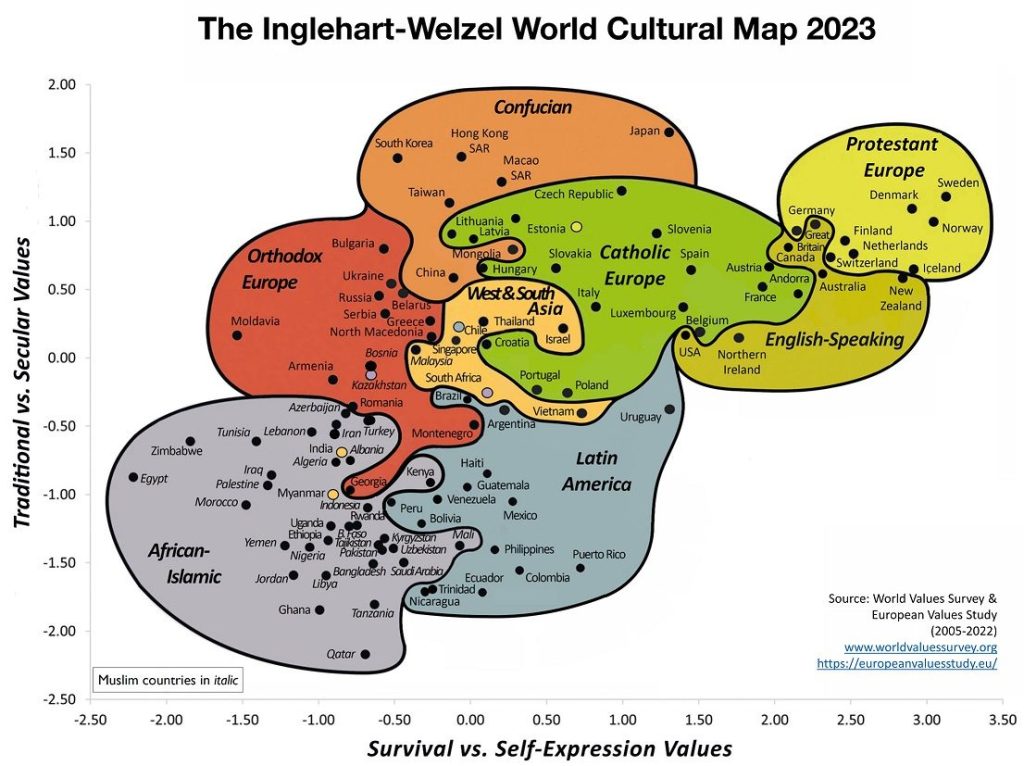
The World Values Survey measures the survival versus self-expression dimension through factor analysis of ten indicators (five per dimension), selected for cross-wave comparability, every 5 years. Key items tapping this axis include materialist versus postmaterialist priorities (e.g., maintaining order and fighting inflation versus giving people more say in government and protecting freedom of speech), tolerance of outgroups (notably acceptance or rejection of homosexuality as a sensitive proxy), interpersonal trust, subjective well-being (life satisfaction and happiness), political activism and demands for participation, and related attitudes toward gender equality and environmental protection. These capture a broader syndrome of tolerance, trust, civic engagement, and autonomy versus insecurity-driven materialism.
Go to Secular-rational values.
Go to Modernization.
References
World Values Survey. (n.d.). Findings and insights and The Inglehart-Welzel cultural map. https://www.worldvaluessurvey.org