
Image by rawpixel.com from Magnific.
Secular-rational values prioritize rationality, science, and secular sources of authority
Secular-rational societies, according to Inglehart and Welzel, prioritize rationality, science, and secular sources of authority over religious or traditional ones. These societies place less emphasis on religion as a central guide for life and exhibit greater acceptance of practices once considered morally taboo, such as divorce, abortion, euthanasia, and suicide. Deference to authority from God, family, or nation declines in favor of individual autonomy, scientific reasoning, and bureaucratic processes. National pride tends to be lower, and traditional family values are less rigidly upheld. This orientation reflects a broader modernization-driven shift, which could be described as the replacement of religion and superstition with science and bureaucracy as the basis of behaviour and authority relations in a society.
Traditional societies represent the opposite pole. They emphasize the importance of religion, strong parent-child ties, deference to authority, absolute moral standards, and conventional family values. People in these societies typically reject divorce, abortion, euthanasia, and suicide as unacceptable. High levels of national pride and a nationalistic outlook are common, alongside priorities of social conformity, respect for parents and elders regardless of their behavior, and the family’s central role in providing security, moral guidance, and identity. Religion often intertwines with national identity and daily authority structures.
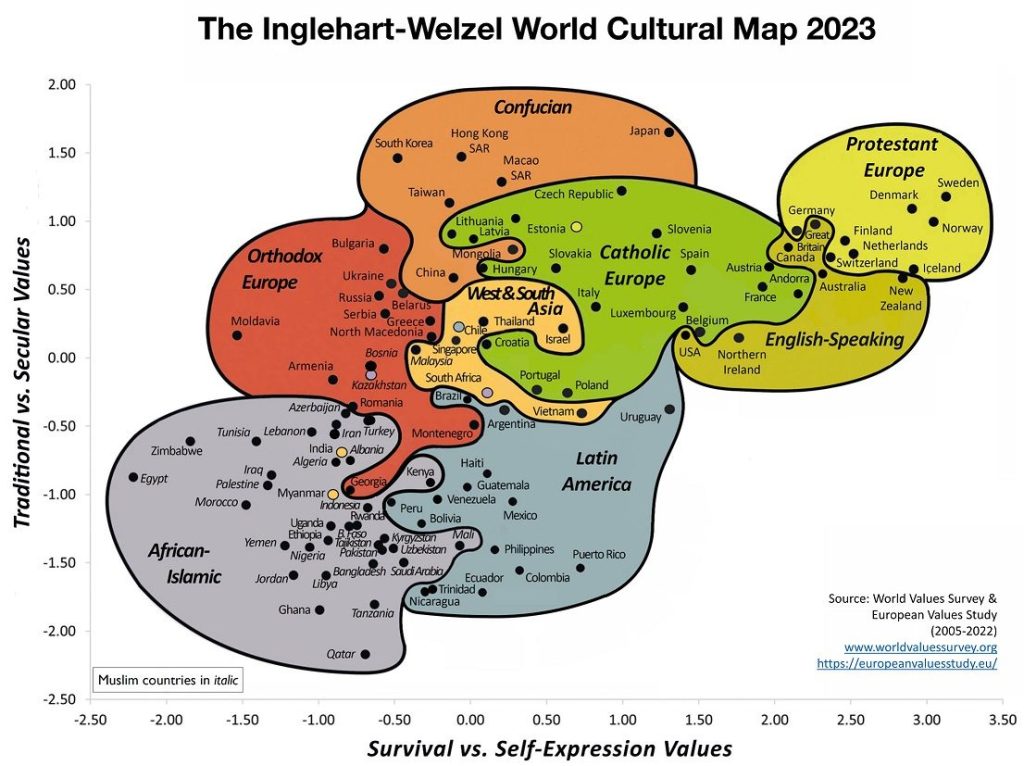
The World Values Survey measures this dimension through factor analysis of ten indicators (five per dimension) selected for consistency across survey waves, every 5 years. Key items tapping the traditional–secular/rational axis include questions on the personal importance of God/religion, the justifiability of abortion/divorce/euthanasia/suicide, levels of national pride, the importance of parent-child ties (e.g., making parents proud), and deference to authority or traditional family values. These serve as reliable proxies for broader underlying cultural contrasts.
Go to Self-expression values.
References
Inglehart, R., & Welzel, C. (2005). Modernization, Cultural Change, and Democracy: The Human Development Sequence. Cambridge University Press.
World Values Survey. (n.d.). Findings and insights and The Inglehart-Welzel cultural map. https://www.worldvaluessurvey.org