Modernization and cultural change
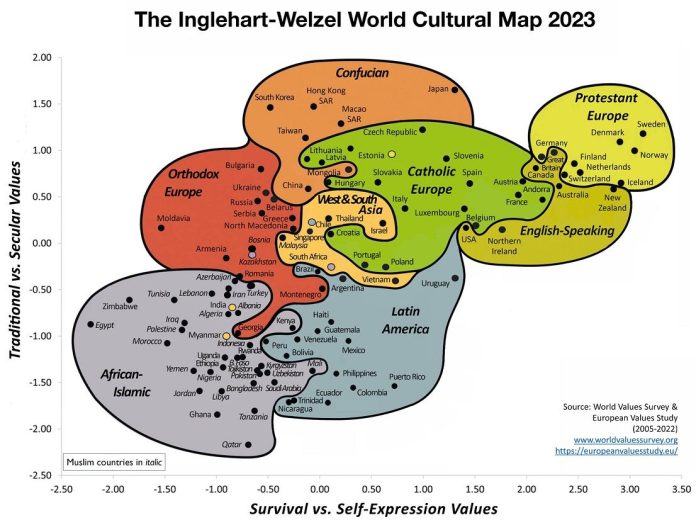
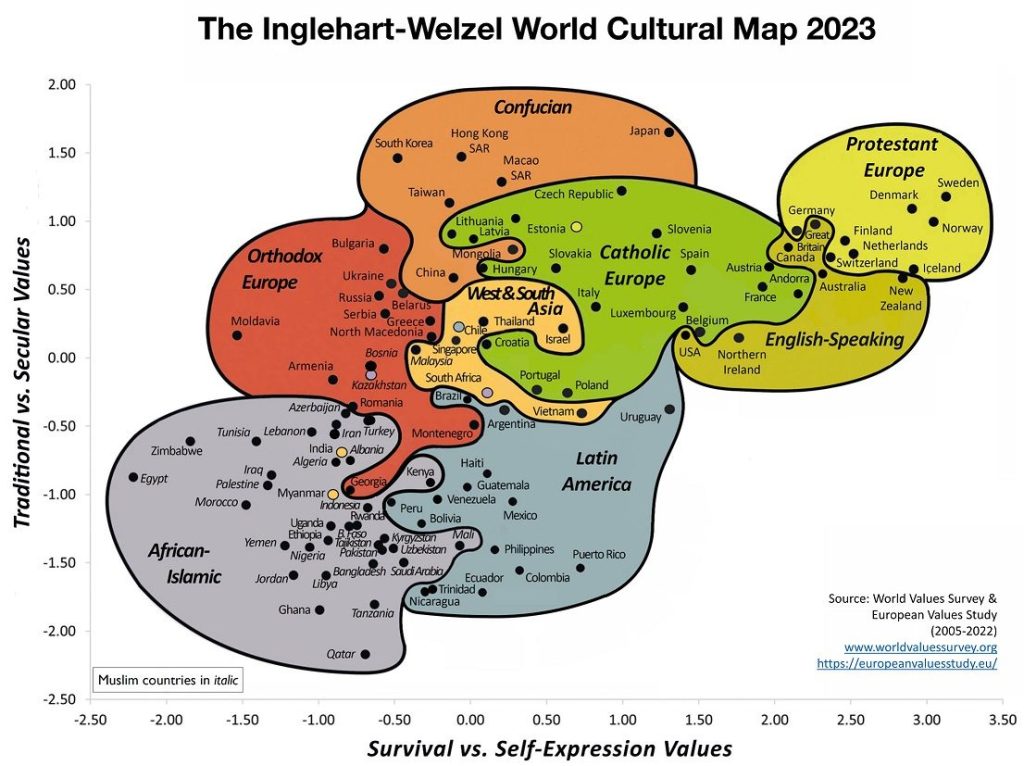
Inglehart and Welzel link modernization to cultural change through two value dimensions derived from World Values Survey data: traditional vs. secular-rational values (tied to industrialization) and survival vs. self-expression values (tied to post-industrialization).
The main path Inglehart outlines runs from socioeconomic development to value shifts to institutional outcomes. Rising existential security—via industrialization (shifting work from agriculture) and then post-industrial service economies—reduces reliance on religion, authority, and material survival. Younger cohorts, socialized in greater security, gradually adopt secular-rational values (less deference to tradition) and self-expression values (greater emphasis on autonomy, tolerance, and subjective well-being). These emancipative orientations then support democracy, gender equality, and effective governance, creating a human development sequence.
Values can accelerate modernization through positive feedback. Once self-expression values spread, they foster creativity, interpersonal trust, and demands for responsive institutions. These traits fuel innovation, entrepreneurship, and knowledge-based growth while reinforcing democratic accountability—sustaining the very prosperity that produced the value shift in the first place.
In contrast, societies that emphasize traditional and survival values tend to show more gradual shifts associated with modernization. These orientations are common in the lower-left quadrant of the Inglehart–Welzel map, where many African and Arab countries (such as Zimbabwe, Morocco, Jordan, and Egypt) cluster, reflecting strong emphasis on religiosity, deference to authority, national pride, and physical/economic security. Similar patterns appear in other cultural zones shaped by distinct historical legacies—for instance, residual survival-oriented attitudes in parts of post-communist Eastern Europe, or the interplay of traditional hierarchical norms with rapid economic change in certain Confucian-influenced Asian societies.
Cultural heritage—whether religious, communist, or Confucian—combined with ongoing insecurity can reinforce orientations toward conformity and group solidarity rather than rapid secularization or individual autonomy. These patterns are associated with slower emergence of the tolerant, participatory orientations linked to broad-based innovation, gender equality, and accountable institutions, and they often correlate with more uneven long-term development even when GDP growth occurs. Path dependence means that diverse cultural legacies endure and shape trajectories differently; the full sequence of value change and institutional reinforcement observed in high-income Protestant European societies is therefore not automatic and varies across historical contexts.
Overall, Inglehart and Welzel view values as both outcome and driver: development shapes them predictably, yet they powerfully condition whether modernization deepens or stalls.
The next 2 posts will explain more in-depth the characteristics of secular and self-expressive societies, in contrast with more traditional and survival-based societies.
References
World Values Survey. (n.d.). Findings and insights and The Inglehart-Welzel cultural map. https://www.worldvaluessurvey.org